To recap, the first post of this series finished determining the Final GRC of our CONOPS, which was not reduced by the proposed ground mitigations and ended up being 2. Today, the post will cover the steps that will determine the air risk class associated to our CONOPS (roof inspection of a tall building over a controlled ground area in VLOS).
Step 4. Initial Air Risk Class (ARC)
- WHAT ARE YOU BEING ASKED?
The ARC is a qualitative classification of the rate at which a UAS would encounter a manned aircraft in typical generalized civil airspace. Initial ARC is determined by following a decision tree provided by JARUS. In the mentioned tree, the airspace is categorized into 13 aggregated collision risk categories. These categories were characterized by altitude, controlled versus uncontrolled airspace, airport/heliport versus non-airport/non-heliport environments, airspace over urban versus rural environments, and lastly atypical (e.g., segregated) versus typical airspace.
- IN OUR EXAMPLE…
The following operational limitations related to the air risk are defined for this operation:
- Below 120m / 400 ft AGL
- Out of heliport/airport areas
- Controlled airspace (CTR)
The Air Risk Class (ARCs) associated with this operation is as shown in diagram below.

By following the decision tree, our initial ARC is ARC-c.
Step 5. Application of strategic mitigations to determine the residual ARC
- WHAT ARE YOU BEING ASKED?
If an applicant considers that the generalized Initial ARC assigned is too high for the condition in the local Operational Volume, then it is possible to apply different mitigations in order to reduce it, as we did in the previous post with the GRC.
| Note: The Air Mitigation Process by SORA is dense and can get significantly complex, if the reader is interested in this part, we encourage you to carefully read Annex C of JARUS guide to SORA process. |
- IN OUR EXAMPLE…
The first step is to determine the initial Air Risk Category using the potential Air Risk Encounter rate based on known airspace densities.
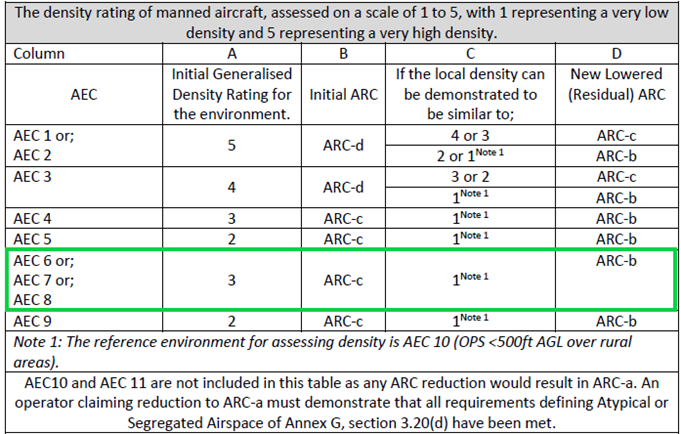
Strategic Mitigation consists of procedures and operational restrictions intended to reduce the UAS encounter rates or time of exposure, prior to take-off. Strategic Mitigations are divided into:
- Operational Restrictions
- Mitigations that bound the geographical volume in which the UAS operates
- Mitigations that bound the operational time frame
- Mitigations that limit the time of exposure to the operational risk
- Common Structures and Rules
- Common Flight Rules
- Common Airspace Structure
Since the flight will take place in a limited and defined area, the following operational mitigation is applied:
- Bounding of the operational volume. The flight geography will be limited to the area of the inspected building and an altitude equal to the height of the building plus 30m.
| Note: the applicant should provide enough evidence to prove the bounding is effective and reduces the airspace encounter rate. This should be done depending on the characteristics of the operation. |
Step 6. Tactical Mitigation Performance Requirement (TMPR) and Robustness Levels
- WHAT ARE YOU BEING ASKED?
Tactical Mitigations are applied to mitigate any residual risk of a mid-air collision needed to achieve the applicable airspace safety objective. Tactical Mitigations will take the form of either “See and Avoid” (i.e., operations under VLOS) or may require a system that provides an alternate means of achieving the applicable airspace safety objective (operation using a DAA, or multiple DAA systems).
- IN OUR EXAMPLE…
Given that our operations are going to be executed in VLOS and this is considered a mitigation measure by itself, the operator does not need to meet TMPR robustness requirements. However, the applicant has a VLOS de-confliction scheme, in which the methods for detection and the associated criteria applied for the decision to avoid incoming traffic are documented.
Step 7. SAIL Determination
- WHAT ARE YOU BEING ASKED?
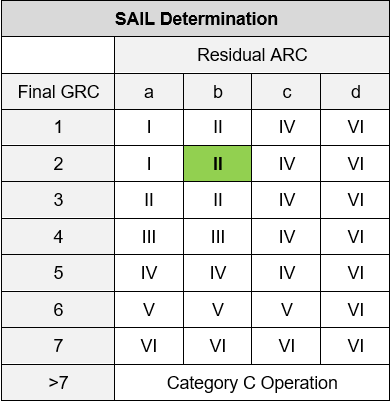
The SAIL parameter consolidates the ground and air risk analyses and drives the required activities. The SAIL represents the level of confidence that the UAS operation will stay under control.
- IN OUR EXAMPLE…
After determining the Final GRC and Residual ARC, it is now possible to derive the SAIL associated with the proposed ConOps.
Step 8. Identification of the Operational Safety Objectives (OSO)
- WHAT ARE YOU BEING ASKED?
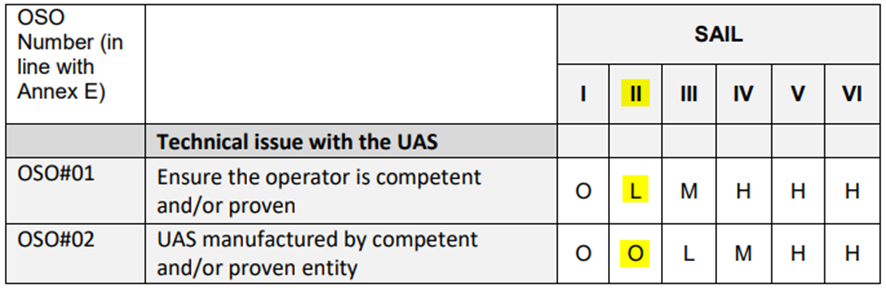
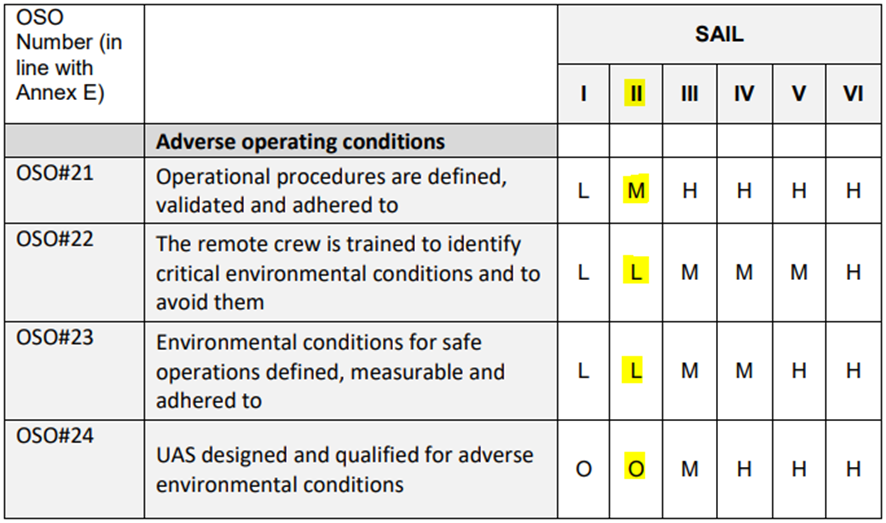
The last step of the SORA process is to use the SAIL to evaluate the defences within the operation in the form of operational safety objectives (OSO) and to determine the associated level of robustness. Table 6 provides a qualitative methodology to make this determination. In this table, O is Optional, L is recommended with Low robustness, M is recommended with Medium robustness, H is recommended with High robustness. The various OSOs are grouped based on the threat they help to mitigate; hence some OSOs may be repeated in the table.
- IN OUR EXAMPLE…
SAIL II corresponding to this operation is highlighted in Table 8 to show the required level of robustness for the different OSOs.

Step 9. Adjacent area/airspace considerations
- WHAT ARE YOU BEING ASKED?
The objective of this section is to address the risk posed by a loss of control of the operation resulting in an infringement of the adjacent areas on the ground and/or adjacent airspace. These areas may vary with different flight phases.
- IN OUR EXAMPLE…
As indicated in the SORA (Main Body), the objective of this section is to address the risk posed by a loss of control of the operation resulting in an infringement of the adjacent areas on the ground and adjacent airspace.
In the context of this operation, the safety requirements applied are the following:
No probable failure of the UAS or any external system supporting the operation shall lead to operation outside of the operational volume.
Compliance with the requirement above shall be substantiated by a design and installation appraisal and shall minimally include:
- design and installation features (independence, separation and redundancy)
- any relevant particular risk associated with the ConOps
And that’s it! Now, once you have compiled the relevant evidence depending on the complexity of the operation, you can submit the request to the competent authorities and, hopefully, it will get approved!
0 Comments